Linear's sales deck is 9 slides. Here's why it works
Most SaaS sales decks run 25 to 40 slides. Linear's 2023 sales deck runs nine. That isn't aesthetic discipline. It's the argument. Linear's whole pitch is that engineering tools have grown slow and bloated, and a 40-slide deck would be the wrong way to make that case.

The structure of Linear's 9-slide pitch deck
Stripped to its skeleton, the deck does this:
- Cover. "It's time for a change. Rejuvenate your product team."
- Product overview. Linear bundles issue tracking, sprint planning, and roadmaps into one tool.
- Problem 1. Current trackers feel like a chore.
- Problem 2. A tool nobody likes produces bad data, which produces bad decisions.
- Solution. A tool the team will actually enjoy using.
- Differentiation. Opinionated workflows, low setup, sub-100ms speed.
- Social proof. Cash App and Watershed testimonials, plus easy migration from Jira and Asana.
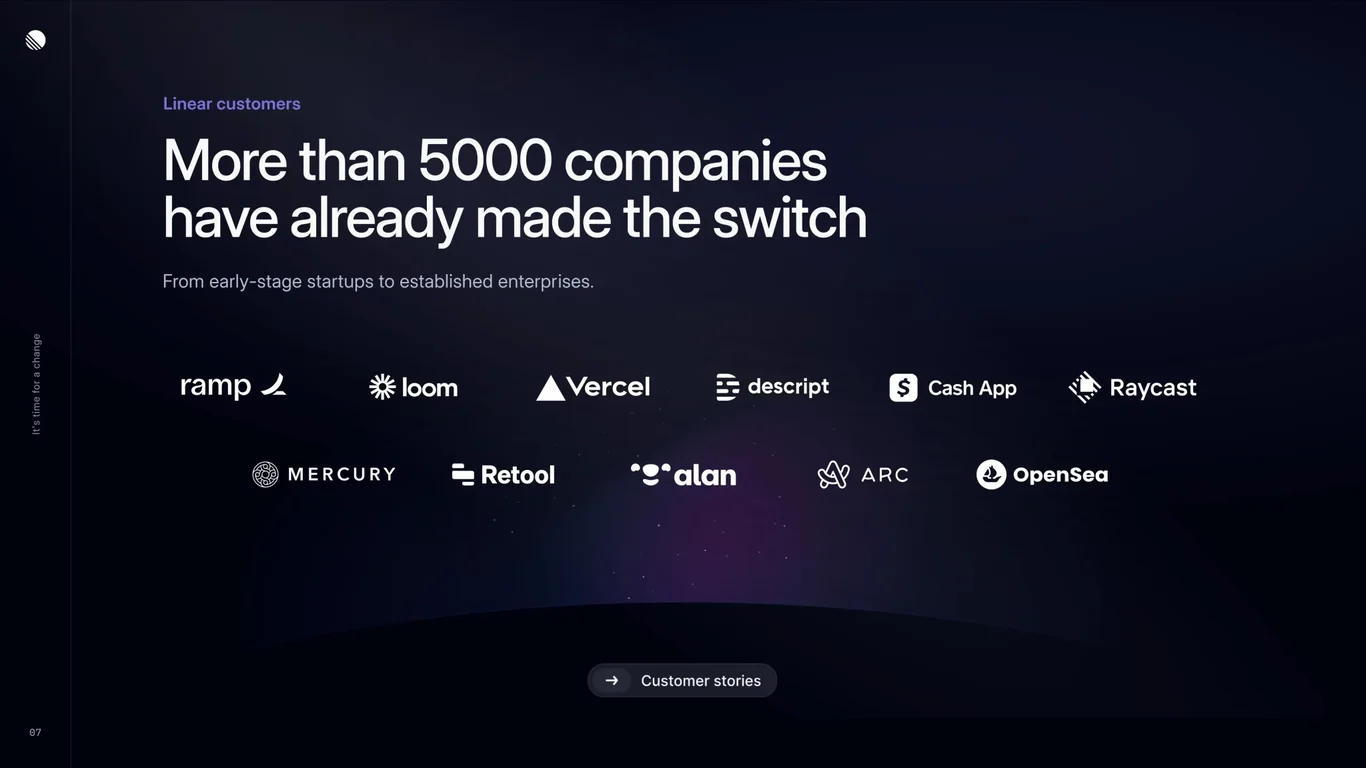
- Traction. 5,000+ companies including Ramp, Loom, Vercel.
- Contact. Free account or sales contact.
There's no team slide. No roadmap. No financials. No competitive matrix. The deck is built around a single contrast (bad tools vs. good tools), and every slide stays inside that frame.
What works
Two problem slides instead of one
Most decks compress the problem onto a single page and rush to the solution. Linear gives the problem two slides, because the second one ("a tool nobody likes is not a useful tool") is the actual insight. The first slide states a fact: Jira is bad. The second slide explains why it matters: bad tools produce bad data, and bad data produces bad decisions. Buyers nod at the first. The second is what gives them language to take the pitch internally.
The traction slide does one thing
Slide 8 is a single number, 5,000+ companies, over a logo wall featuring Ramp, Loom, Vercel, Descript, Cash App, Raycast, Mercury, Retool, Alan, Arc, and OpenSea. No revenue figures. No growth curve. No retention chart. The argument is purely social: these companies you respect already moved.
Migration is buried in the testimonial slide
Linear doesn't dedicate a whole slide to "we have Jira and Asana importers." It's mentioned in passing on slide 7, tucked between two customer quotes. That placement frames migration as a non-issue rather than a feature. It's an obstacle the deck refuses to dwell on.
The closing slide gives two paths, not a CTA
Slide 9 splits cleanly: free account on the left, contact sales on the right. No "book a demo" hard close. The deck assumes the reader is sophisticated enough to self-route, which is consistent with the audience Linear actually sells to.
What to consider
The deck has very little proof of why Linear is fast. "Sub-100ms" appears as a claim, not a demonstration. There's no benchmark, no comparison, no chart. For a deck whose central differentiator is speed, the absence of a single "here's what 100ms feels like" slide is striking. It works because Linear's audience already believes the claim from product trials, but a colder audience would have nothing to push against.
There's also no slide that addresses Notion, Height, Shortcut, or any modern competitor. The deck pretends Jira is the only opponent. That's strategically clean, but anyone evaluating Linear in 2023 was almost certainly comparing it to peers, not to Jira.
The takeaway
The 9-slide length isn't the lesson. The lesson is that a sales deck only needs to make one argument, and Linear's deck refuses to make any other. Engineers wanted a tool that didn't feel like punishment. Everything else (pricing, integrations, migration, even the team) is either implied or deferred.

If you're working on a deck for a category-defining product, the Linear sales deck is worth reading slide by slide. Decks for products that lack a clear villain (most early-stage products) usually need more pages, because the buyer hasn't yet agreed on what's broken.
Read next: the traction slide study, which uses Linear's slide 8 as one of seven traction patterns and explains when to copy that single-number-plus-logo-wall approach and when to pick something else.