Traction slides: seven patterns from real pitch decks
The traction slide is the page investors read first and read longest. Founders know this, which is why traction slides are usually the most overworked slide in the deck — too many numbers, too many lines on the chart, too many adjectives — and end up the least convincing. The decks worth studying are the ones that pick a single shape for the slide and let that shape carry the argument.
Seven patterns, drawn from seven real pitch decks in the gallery. None of these are templates to copy. They're shapes — each one fits a specific kind of company at a specific stage. Get the match wrong and the strongest pattern in the world reads as overstatement.
1. The single-number + logo wall (Linear)
Linear's pitch deck compresses traction onto a single page: the number 5,000+ over a logo wall featuring Ramp, Loom, Vercel, Cash App, Mercury, OpenSea, and others. No revenue line. No retention chart. No churn cohort.
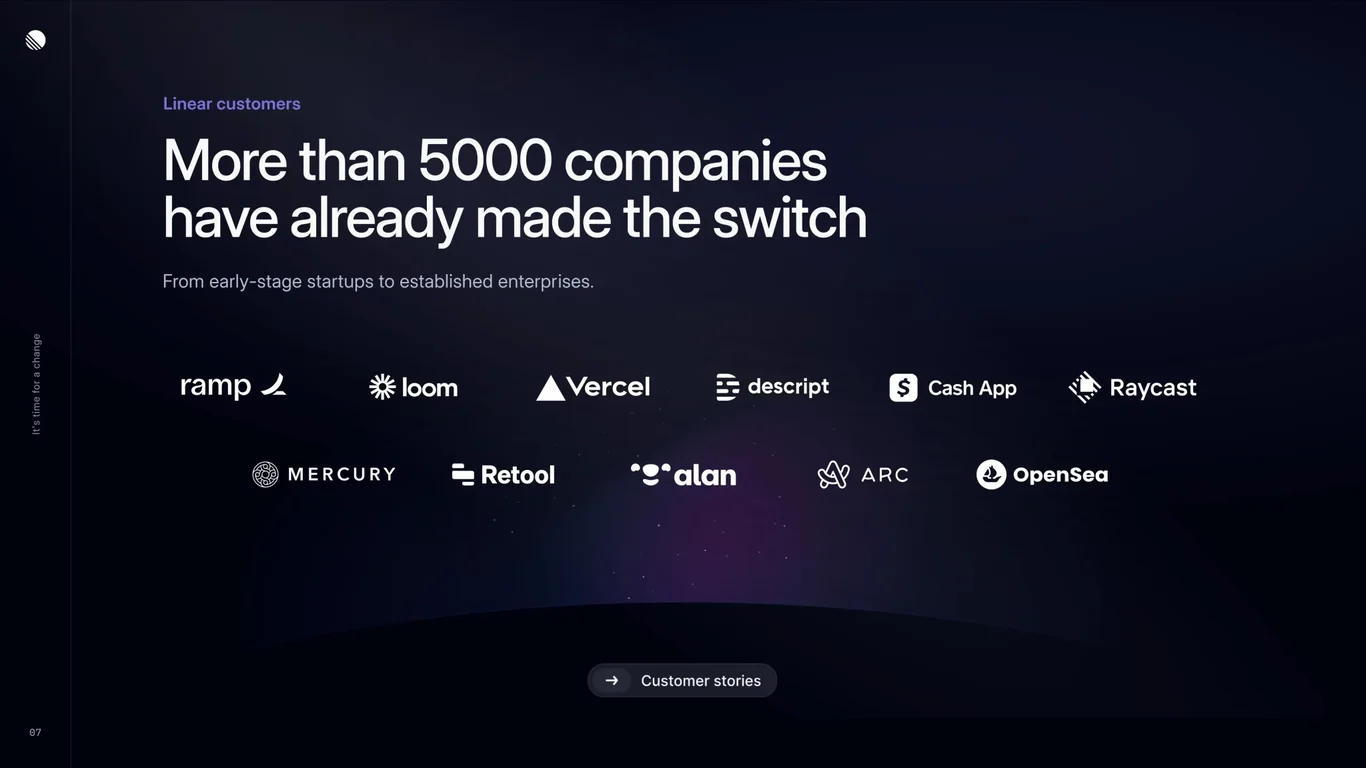
This pattern works when the names in the logo wall are stronger than any growth chart. Investors looking at Linear in 2023 already believed the curve was going up; what they wanted to see was who was already using it. Putting twelve recognizable companies in front of one large number does that work without spending a slide on a chart anyone could have predicted.
It fails for early-stage companies with logos no one knows. A logo wall of unfamiliar names reads as filler.
2. The growth curve with disciplined unit economics (Smalls)
Smalls' deck uses an 8x subscriber growth chart since 2020, but the slide spends nearly as much space on CAC and contribution profit as it does on the curve itself. The pairing is the point: the company doesn't just grow, it grows efficiently.
The pattern works when growth alone isn't the differentiator. By 2022, "we're growing fast" was no longer a winning slide for D2C — every deck claimed that. The hard claim was disciplined growth, and the slide is built to make that case in one page.
3. The cohort progression (Lunchbox)
Lunchbox's traction slide shows three numbers: 18% first-party adoption at launch, 31% within three months, 49% within six months. The numbers are arranged as a left-to-right progression with a visible inflection between months three and six.
The structural lesson is that a cohort with three points is more convincing than a curve with twenty. The reader doesn't need to count gridlines to see the trend; the three numbers say it. And because each number is anchored to a milestone (launch, 3 months, 6 months), the reader can extrapolate the next data point in their head — which is exactly what a good traction slide is supposed to make them do.
4. The waitlist (Diagram)
Diagram's pitch puts a 16,000+ designer waitlist at the heart of its early traction. No revenue. No active users. Just demand.
This pattern is honest for pre-launch products. A waitlist measures interest, and interest is the right metric to lead with when the product isn't shipping yet. Where it gets risky is when the waitlist is the only number — investors know waitlists overstate intent. Diagram pairs it with a separate user adoption page once the product is in the hands of design teams, which makes the waitlist read as one moment in a sequence rather than the whole pitch.
5. The cultural milestone (Arkive)
Arkive's traction slide doesn't lead with a number at all. It leads with a single acquisition: the ENIAC Patent (the founding patent for one of the first computers). The number — 250 founding members — is secondary. Six future acquisition rounds are listed below.
This is the pattern that works when the company's traction is qualitative. For a community-driven museum acquiring historical artifacts, "how many members" is the wrong question. "What did the members buy" is the right one. The slide reframes the metric to match the business.
It fails for software companies. A SaaS deck that leads with a single contract signed instead of revenue or users will read as evasive.
6. The engagement metric stack (Perplexity)
Perplexity Ads' deck splits traction into two slides: monthly active user growth and query volume / engagement. The split is deliberate. MAU answers "is the product getting adopted?" Query volume answers "is the product getting used?" Both are necessary; neither is sufficient.
For consumer-facing AI products, this two-slide pattern handles a problem that earlier tech companies didn't have to face. A chat interface can have high MAU and low engagement, or vice versa, and the interaction of the two metrics is what tells the story. One chart wouldn't.
7. The community ownership distribution (Yuga Labs)
Yuga Labs' Bored Ape pitch treats traction as community participation data — ownership distribution across the BAYC holder base, not revenue or downloads. For a brand whose business model is community ownership, the relevant traction metric is how distributed the ownership is. A concentrated holder base would be a weakness; a distributed one is the moat.
This pattern only works for companies whose actual product is a community. For most software, it's the wrong slide.
What the seven patterns share
Every one of these slides answers a single question. Which companies trust us. How fast we grow with what efficiency. How quickly the product takes hold. Whether there's demand. What we've actually acquired. Whether the product is used. Whether the community is real. The patterns aren't interchangeable because the questions aren't.
The bad traction slide tries to answer all of them. It shows revenue, MAU, engagement, retention, NPS, CAC, LTV, and a logo wall on one page, and ends up answering nothing. The good traction slide picks the question that matters most for this business at this stage and refuses to dilute the answer.
What to avoid
- Charts with no inflection. A revenue line going steadily up to the right is the lowest-information traction shape. Either show an inflection (Smalls, Lunchbox) or use a different shape entirely.
- Logo walls with unfamiliar names. A wall of logos that an investor has to squint at hurts the slide. The Linear pattern only works when the names land on first read.
- Multiple competing metrics on one page. If you have MAU, revenue, retention, and NPS, give the most important one its own page and treat the others as supporting evidence on a different slide.
- Vanity metrics. Anything you can game — page views, free signups, app downloads — needs to be paired with a quality metric, or the slide does damage.
Takeaway
The traction slide is a question-answering slide. The shape of the slide should be the shape of the most important question. Linear's question is "who?" Smalls' question is "how efficiently?" Lunchbox's question is "how fast does it spread?" Diagram's is "is there demand?" Arkive's is "what did you actually do?" Perplexity's is "is it being used?" Yuga's is "is the community real?"
If you're working on a pitch deck and your traction slide doesn't have an obvious question, that's the work. Pick the question first, then design the slide that answers it.
Read next: the Linear sales deck breakdown, which spends a single slide on traction and refuses to do anything else with it, or the pitch deck cover-slide study for the slide that runs into traction immediately afterward.