Frame.io's brand guide: when the product category writes the system
There's a small genre of brand guidelines built around a single environmental observation. Frame.io's 2023 brand guide belongs to it. The whole system descends from one fact about the audience: people who edit video work in dark rooms with cast light bouncing off monitors and walls. Once you accept that as a foundation, the cobalt-on-violet palette, the cinematic photography direction, the gradients — all of it becomes a single argument rather than a list of decisions.
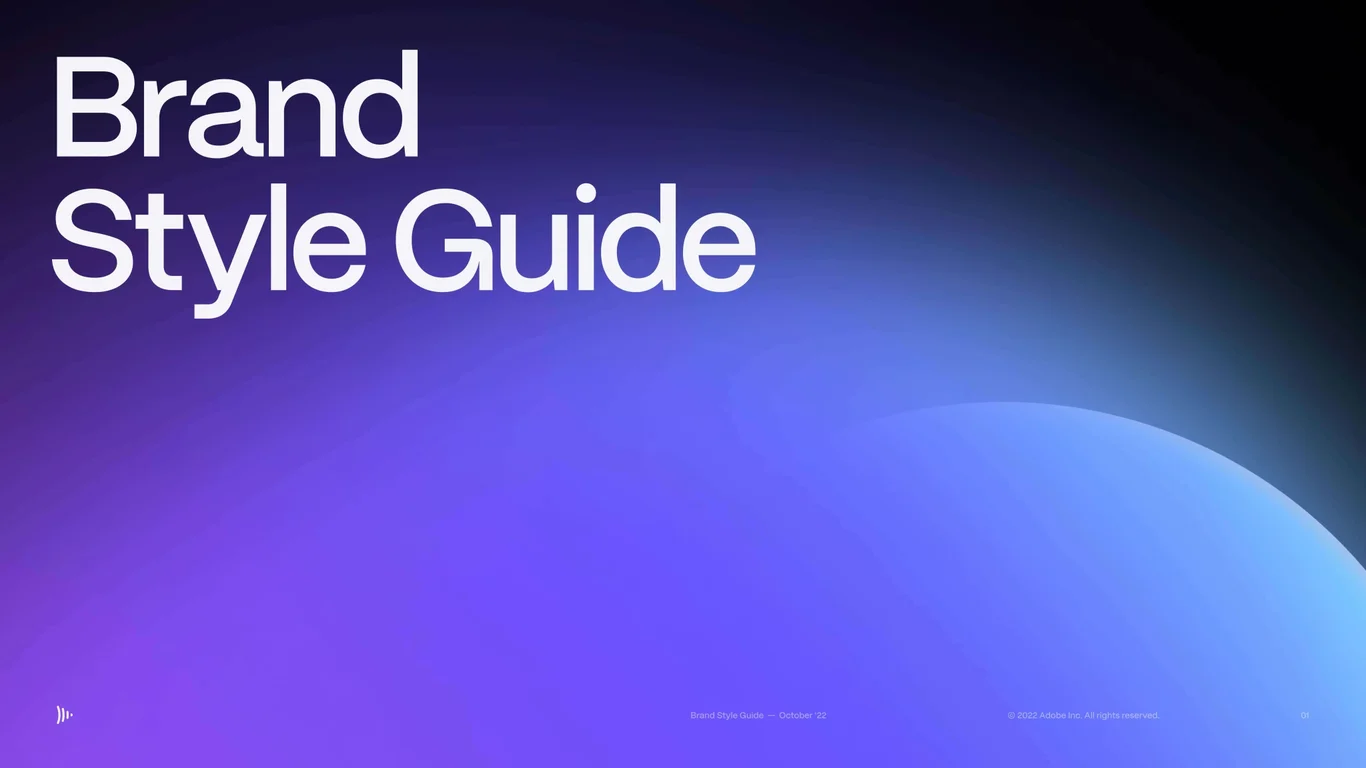
Frame.io was acquired by Adobe in 2021 for around $1.3B. The brand guide here is the post-acquisition system, which makes the constraints interesting: it had to feel premium enough to live next to Adobe properties, but distinct enough that it doesn't just become "Adobe Cloud's video tab." This is the third in a small trilogy on this blog with the Monzo brand guide and the OpenAI brand guide, and Frame.io's choices fall in a different place than either.
The structure of the 18 slides
Three sections, five subsections inside the middle one:
- Mission (slides 3–6). Four brand principles, each anchored by a single environment photograph.
- Foundations (slides 7–13). Logo system (4 slides), then color palette (2 slides).
- Platform (slides 14–17). Photography direction, gradient blending, and area lighting — the rules for how the system shows up in campaigns.
- Closing (slide 18).
The proportions matter. Logo and color rules — the "rulebook" parts most brand guides spend most of their pages on — get six slides. Photography and lighting direction get four. The split tells you that Frame.io considers the image system as much a rule as the logo system.
What works
Brand principles that are workplace observations, not adjectives
Most brand-principle slides use words that could apply to any company. Trusted, friendly, innovative. Slide 4 names four — undeniable, premium, professional, cinematic — and only one of them ("cinematic") is category-specific on its face. But the photography attached to each principle on slides 5 and 6 fixes that. Slide 5 is a person at a video edit bay in a darkened room. Slide 6 is a designer in a brick studio with warm lamp light.
The principles read as adjectives. The slides read as locations. The locations are where the audience actually works. Once you've seen the pairing, the words get specific in a way the words alone don't manage.
The logo gets four slides because logos for software get used in motion
Slides 8–11 cover symbol usage, color variants for dark / light / cobalt backgrounds, clearspace specs, and one slide just on optical centering. The optical-centering slide is the one to notice — it documents that the Frame.io symbol has an arrow shape that creates an optical illusion when geometrically centered, so the metric center is intentionally offset to the right edge of the second bar.
That kind of detail (visible on slide 11) only matters at small sizes and in motion — exactly where a video collaboration logo lives. App icons, video player chrome, watermarked review screens. The brand guide encodes the constraint instead of relying on designers to discover it.
Photography direction is named, not just shown
Slide 14 names the photography technique the brand uses: cast light. The lighting cast off a screen, a window, a wall — light with a source you can almost see but not quite. By calling it a name, the guide gives non-photographers a vocabulary to brief work. A campaign producer doesn't need to recreate a single reference image; they need to know that cast light is the rule, and they can find the rule in their own location.
This is the move most brand guides skip. They show photography examples without naming them, and a year later the photography drifts because the rule was never made portable. Naming a technique outlives the original asset library.
The gradient rule earns its slide
Slide 16 shows how the four primary colors blend into gradients. This is the rule that does the actual heavy lifting on Frame.io's marketing site and product launches — almost every campaign visual is a gradient drawn from these four colors, sometimes with a fifth variant. For a software brand whose product is mostly grayscale UI inside a dark editor, the gradient system is where Frame.io's color identity lives. The guide treats it as foundational, not decorative.
What to consider
The contents page is more legible than the brand structure
Slide 2 groups the guide as Mission / Foundations / Platform / Contact. By the end of the deck, "Platform" turns out to mean image system, not what most software companies mean by "platform." For an internal Adobe audience, the word "platform" might be confusing — the company already has a Platform team. Calling it Imagery or Application would name the section more clearly.
Color appears late and briefly
The four-color primary palette (Cobalt, Electric, Iris, Coral) gets one slide, with light/dark variants and HEX/RGB/HSL specs. The extended palette is one more slide. Two slides on color, in a system whose color identity is its single most distinctive asset, feels like a missed opportunity to encode rules — color combinations to use, color combinations to avoid, when secondary colors lead vs. follow. The Monzo guide spent significantly more pages on its single Hot Coral. Frame.io has four primary colors and gives them about the same total real estate.
No don't-do slides
The guide is entirely positive. Cast light is, gradients blend, the symbol centers optically. There are no "don't" slides — no examples of what stretches the system past its breaking point, no logos misused, no gradients applied wrong. For a brand acquired into a much larger parent company, that absence will create real questions when designers in another part of Adobe try to extend the system into something Frame.io's brand team didn't anticipate.
Takeaway
Compared with the Monzo and OpenAI brand guides, Frame.io is the most product-category-determined of the three. Monzo's guide enforces discipline around a single primary color. OpenAI's enforces an empty-vessel philosophy that hands authorship to the work. Frame.io's enforces an environment — the dark editing room, the cast light, the cinematic frame — and the rest of the system inherits from that.
If you're working on a brand guide for a product whose audience has a recognizable workplace, the structural lesson is that the workplace itself can be the foundational rule. Frame.io built a brand system out of a room.
Read next: the Monzo brand guide breakdown, which makes the opposite choice — letting a single primary color carry almost the entire brand identity — or the full Frame.io guide at slides 11, 14, and 16.